MATERIALS AND SUPPLIES
To get started with your online crochet course, you’ll need a few essential materials. These supplies are beginner-friendly and will help you learn the basics of crochet effectively.
Essential Materials:
- Yarn: Choose any color you like! For beginners, a worsted weight yarn is recommended as it is easy to work with and forgiving for new crocheters.
- Crochet Hook: A size G (4.0mm) or H (5.0mm) crochet hook is ideal for most worsted weight yarns.
- Scissors: A pair of sharp scissors will help you cut your yarn cleanly.
- Tapestry Needle: This is used for weaving in the ends of your project once you finish crocheting.
Each of these materials plays a crucial role in your crochet journey. The yarn is your primary medium, while the crochet hook is your tool for creating stitches. Scissors are necessary for cutting yarn, and a tapestry needle is essential for finishing your projects neatly.
IMAGE: A neatly arranged display of yarn, a crochet hook, scissors, and a tapestry needle.
ALT: Essential materials for an online crochet course including yarn, a crochet hook, scissors, and a tapestry needle.
Best Yarn for Online Crochet Course
When selecting yarn for your projects, worsted weight acrylic or cotton yarns are excellent choices for beginners. They are widely available, come in various colors, and are easy to handle. Choosing a yarn that is smooth and not too fuzzy will help you see your stitches clearly, making it easier to learn.
Suitable Yarn Substitutions
If you want to use a different yarn, consider alternatives that are similar in weight and texture. Always check the yarn label for the weight category and ensure it matches the recommended worsted weight. Remember, the texture and ease of use are important, so opt for yarns that feel comfortable in your hands.
Crochet Hook and Additional Tools
For this course, a size G (4.0mm) or H (5.0mm) crochet hook is recommended. These sizes work well with worsted weight yarn and are comfortable for beginners. If you prefer ergonomic hooks, they can provide extra comfort during longer crochet sessions.
In addition to your hook, you may find it helpful to have stitch markers on hand. They can help you keep track of your stitches and rows, especially when working on larger projects.
INTRODUCTION / ABOUT THIS ONLINE CROCHET COURSE!
Welcome to your journey into the world of crochet with our Online crochet course! This course is designed to be accessible and convenient for both beginners and intermediate crocheters. Whether you are picking up a hook for the first time or looking to refine your skills, this course offers a structured approach to learning crochet at your own pace.
Throughout the course, participants will learn essential skills such as basic stitches, various techniques, and project ideas that will help you create beautiful handmade items. You will start with foundational stitches like chain stitch, single crochet, and double crochet, gradually progressing to more complex techniques as you gain confidence.
One of the greatest benefits of learning crochet online is the flexibility it offers. You can revisit lessons as often as you need, allowing you to practice at your own pace and fit your crochet sessions into your schedule. This course also provides opportunities for interaction, enabling you to ask questions and receive feedback, making your learning experience even more enriching.
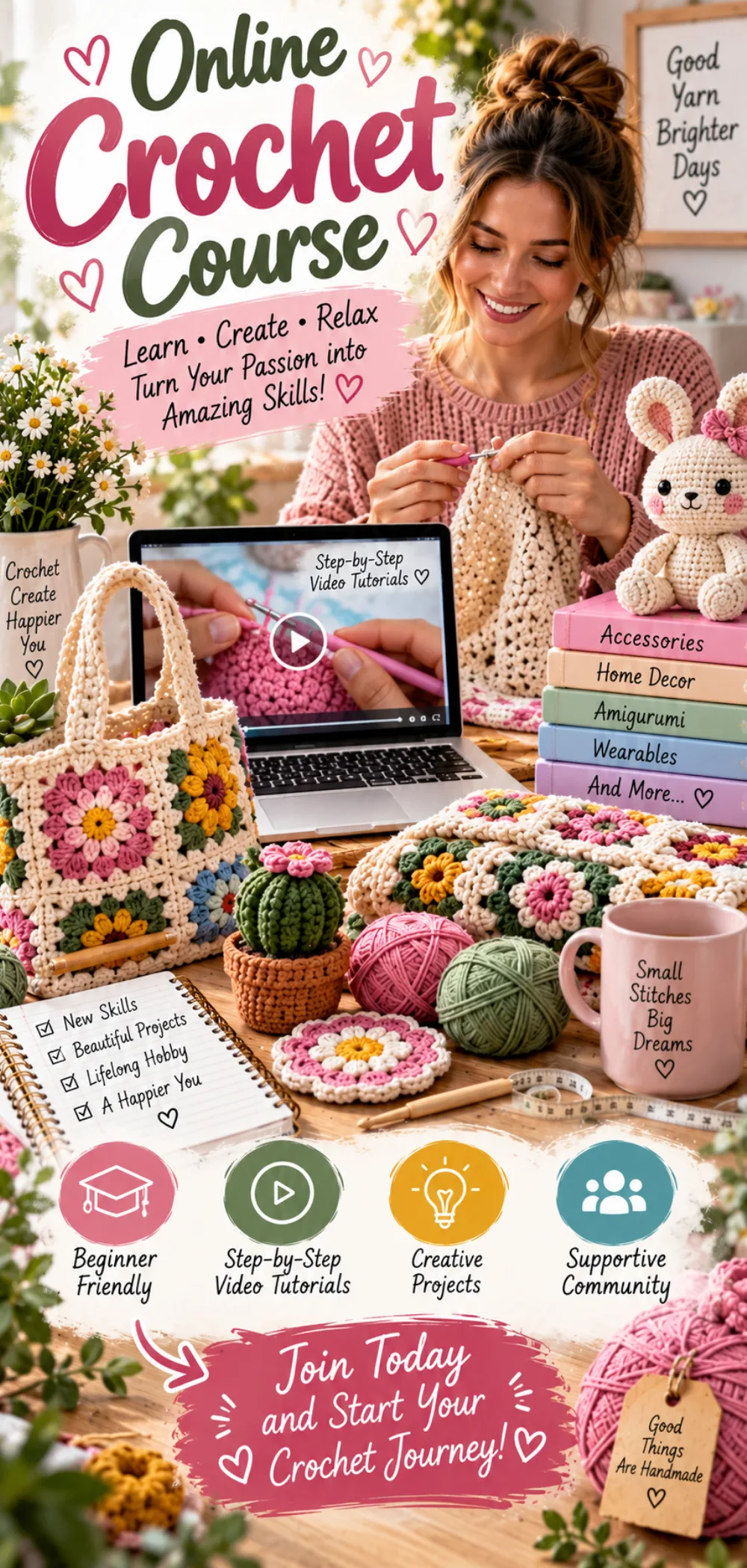
IMAGE: A cozy workspace featuring a laptop with a crochet tutorial on the screen, colorful yarns, and a crochet hook neatly arranged.
ALT: A workspace set up for an online crochet course with yarn, a crochet hook, and a laptop displaying crochet instructions.
ONLINE CROCHET COURSE QUICK OVERVIEW
| Detail | Information |
|---|---|
| Skill Level | Beginner to Intermediate |
| Crochet Terminology | US Terms |
| Yarn Weight | Any (recommended: Worsted) |
| Crochet Hook Size | G or H (4.0mm or 5.0mm) |
| Approximate Finished Size | Varies by project |
| Approximate Working Time | Variable |
| Construction Method | Online Learning |
| Crochet Technique | Basic Stitches and Techniques |
ABOUT THIS ONLINE CROCHET COURSE!
This Online crochet course! is structured to guide you through the wonderful world of crochet, starting from the very basics and gradually introducing more advanced techniques. The course is designed to ensure that you build a solid foundation before moving on to more complex stitches and projects. You will begin by learning essential stitches such as chain stitch, single crochet, and double crochet. As you become comfortable with these foundational skills, you will progress to more intricate techniques, allowing you to expand your crochet repertoire.
One of the key features of this course is its interactive design. You will have opportunities to practice what you learn through hands-on projects, and you can ask questions and receive feedback from instructors and fellow participants. This interaction not only enhances your learning experience but also helps you stay motivated and engaged throughout the course.
Throughout the course, you will have the chance to complete a variety of projects. These may include simple items like scarves and dishcloths, as well as more advanced creations such as hats and home decor items. Each project is carefully selected to reinforce the skills you are learning while allowing you to create beautiful, functional pieces that you can be proud of.
MATERIALS AND SUPPLIES
To get started with your online crochet course, you’ll need a few essential materials. These supplies are beginner-friendly and will help you learn the basics of crochet effectively.
Essential Materials:
- Yarn: Choose any color you like! For beginners, a worsted weight yarn is recommended as it is easy to work with and forgiving for new crocheters.
- Crochet Hook: A size G (4.0mm) or H (5.0mm) crochet hook is ideal for most worsted weight yarns.
- Scissors: A pair of sharp scissors will help you cut your yarn cleanly.
- Tapestry Needle: This is used for weaving in the ends of your project once you finish crocheting.
Each of these materials plays a crucial role in your crochet journey. The yarn is your primary medium, while the crochet hook is your tool for creating stitches. Scissors are necessary for cutting yarn, and a tapestry needle is essential for finishing your projects neatly.
IMAGE: A neatly arranged display of yarn, a crochet hook, scissors, and a tapestry needle.
ALT: Essential materials for an online crochet course including yarn, a crochet hook, scissors, and a tapestry needle.
Best Yarn for Online Crochet Course
When selecting yarn for your projects, worsted weight acrylic or cotton yarns are excellent choices for beginners. They are widely available, come in various colors, and are easy to handle. Choosing a yarn that is smooth and not too fuzzy will help you see your stitches clearly, making it easier to learn.
Suitable Yarn Substitutions
If you want to use a different yarn, consider alternatives that are similar in weight and texture. Always check the yarn label for the weight category and ensure it matches the recommended worsted weight. Remember, the texture and ease of use are important, so opt for yarns that feel comfortable in your hands.
Crochet Hook and Additional Tools
For this course, a size G (4.0mm) or H (5.0mm) crochet hook is recommended. These sizes work well with worsted weight yarn and are comfortable for beginners. If you prefer ergonomic hooks, they can provide extra comfort during longer crochet sessions.
In addition to your hook, you may find it helpful to have stitch markers on hand. They can help you keep track of your stitches and rows, especially when working on larger projects.
CROCHET STITCHES AND TECHNIQUES USED
In this Online crochet course!, you will learn several basic stitches and techniques that are essential for creating a variety of projects. Understanding these foundational stitches will help you build your skills and confidence as you progress through the course.
Before diving into the stitches, it is helpful to have a basic understanding of how to hold your crochet hook and yarn. Familiarizing yourself with the tension of your yarn and practicing your grip will make learning these stitches easier.
Chain Stitch
The chain stitch (abbreviated as ch) is the most fundamental stitch in crochet. It serves as the foundation for many projects, including scarves, blankets, and more. To create a chain stitch, you will start with a slip knot on your hook and then yarn over to pull through the loop on your hook. This process is repeated to create a series of connected loops.
The chain stitch is important because it establishes the starting point for your work. It is used to create the foundation row for most crochet patterns, and understanding how to make it will allow you to begin any project with confidence.
IMAGE: A close-up of a chain stitch demonstrating the technique clearly.
ALT: A close-up view of a chain stitch used in an online crochet course.
Single Crochet and Double Crochet
Once you are comfortable with the chain stitch, you will learn how to perform single crochet (abbreviated as sc) and double crochet (abbreviated as dc) stitches. These two stitches are the building blocks for many crochet patterns.
To perform a single crochet, you will insert your hook into the desired stitch, yarn over, pull up a loop, yarn over again, and pull through both loops on your hook. This creates a tight, dense stitch that is great for projects like dishcloths and amigurumi.
The double crochet stitch is slightly taller and more open than the single crochet. To make a double crochet, yarn over, insert your hook into the stitch, yarn over again, pull up a loop, yarn over, pull through the first two loops, yarn over once more, and pull through the last two loops. This stitch is commonly used in patterns for blankets and shawls, as it creates a lovely drape.
Both single and double crochet stitches are versatile and can be combined in various ways to create beautiful textures and patterns in your crochet projects.
CROCHET ABBREVIATIONS
Understanding crochet abbreviations is essential for following patterns and instructions effectively. Below is a simple table of common crochet abbreviations that you will encounter throughout this Online crochet course!
| Abbreviation | Meaning |
|---|---|
| ch | Chain |
| sc | Single Crochet |
| dc | Double Crochet |
| st | Stitch |
| sl st | Slip Stitch |
GAUGE
Gauge is a crucial concept in crochet that refers to the number of stitches and rows per inch in your work. Achieving the correct gauge is important because it ensures that your finished project will be the right size as intended by the pattern. If your gauge is off, your project may end up too small or too large, which can be frustrating, especially for fitted items like garments.
To determine your gauge, you will need to create a gauge swatch. This is a small sample of crochet that allows you to measure your stitches and rows accurately. Here’s how to make a simple gauge swatch:
Gauge Swatch Tutorial
- Choose Your Yarn and Hook: Use the yarn and crochet hook that you plan to use for your project.
- Make a Slip Knot: Start with a slip knot on your hook.
- Chain Stitches: Chain a number of stitches that is larger than the width you need for your project. A common starting point is to chain 20 stitches.
- Work in Stitches: Follow the stitch pattern you will use in your project for about 4 inches. For example, if your project uses single crochet, work single crochet stitches across your chain.
- Measure Your Swatch: Once you have completed your swatch, lay it flat and measure the width and height. Count the number of stitches and rows within a 4-inch square.
- Adjust if Necessary: If your stitch count is higher than the pattern indicates, try using a larger hook. If it’s lower, switch to a smaller hook. Make another swatch to check your new gauge.
By measuring your gauge and adjusting your tension, you can ensure that your finished projects turn out just as you envision them. Remember, taking the time to check your gauge can save you from potential disappointment later on!
STEP-BY-STEP INSTRUCTIONS FOR YOUR FIRST PROJECT
In this section, we will guide you through creating a simple beginner project: a basic dishcloth. This project is perfect for practicing your crochet skills while creating something useful for your home.
Project Preparation
Before you start crocheting your dishcloth, it’s important to prepare your workspace and gather all necessary materials. Follow these steps:
- Gather Your Materials: You will need your chosen yarn, a size G (4.0mm) or H (5.0mm) crochet hook, scissors, and a tapestry needle.
- Set Up Your Workspace: Find a comfortable and well-lit area to work. Make sure you have enough space to spread out your materials.
- Check Your Gauge: If you want to ensure your dishcloth is the right size, consider making a gauge swatch as described in the previous section.
Step-by-Step Instructions
Now that you are prepared, let’s start crocheting your dishcloth!
Row 1: Start with a slip knot on your hook. Chain 30 stitches (ch 30).
Row 2: In the second chain from the hook, make a single crochet (sc). Continue to single crochet in each chain across the row. You should have 29 single crochet stitches at the end of this row.
Row 3: Chain 1 (ch 1) to turn. In the first stitch, make a single crochet. Continue to single crochet in each stitch across the row. You will again have 29 single crochet stitches at the end of this row.
Rows 4-30: Repeat Row 3 until your dishcloth measures approximately 10 inches square, or until you have completed 30 rows total.
Final Row: After completing your last row, chain 1 and cut the yarn, leaving a tail of about 6 inches. Pull the tail through the last loop to secure it.
Finishing Touches
Now that your dishcloth is complete, it’s time to finish it off:
- Weave in Ends: Use your tapestry needle to weave in the loose ends of yarn. Insert the needle into the stitches on the back of your dishcloth to hide the ends securely.
- Optional Embellishments: If you want to add a personal touch, consider adding a border around your dishcloth using a contrasting color. You can do this by making a round of single crochet stitches around the entire edge.
Congratulations! You have completed your first crochet project. Enjoy using your new dishcloth or gifting it to someone special!
TIPS FOR SUCCESS IN YOUR ONLINE CROCHET COURSE
As you embark on your journey with this Online crochet course!, it’s important to stay motivated and continuously improve your crochet skills. Here are some practical tips to help you succeed:
- Set Realistic Goals: Establish achievable goals for your crochet practice. Whether it’s completing a specific project or mastering a new stitch, having clear objectives can keep you focused and motivated.
- Practice Regularly: Consistency is key in developing your crochet skills. Set aside dedicated time each week to practice. Even short sessions can lead to significant improvement over time.
- Keep a Crochet Journal: Document your progress, projects, and any challenges you encounter. This can help you track your growth and reflect on what you’ve learned.
- Experiment with Different Projects: Don’t hesitate to try various projects that challenge your skills. This will not only keep your interest alive but also expand your crochet repertoire.
- Join Online Crochet Communities: Engage with fellow crocheters through online forums, social media groups, or dedicated crochet websites. These communities can provide support, inspiration, and valuable tips from experienced crocheters.
- Share Your Work: Don’t be shy about sharing your completed projects with others. This can boost your confidence and encourage feedback, which is invaluable for growth.
- Stay Patient and Positive: Remember that learning a new skill takes time. If you encounter difficulties, stay patient and maintain a positive attitude. Celebrate your progress, no matter how small!
By following these tips, you can enhance your experience in the Online crochet course! and develop your skills effectively. Enjoy the process and the creativity that comes with crocheting!
CONCLUSION
Taking an Online crochet course! offers numerous benefits for both beginners and intermediate crocheters. You gain the flexibility to learn at your own pace, revisit lessons as needed, and engage with a community of fellow crafters. Throughout the course, you will acquire essential skills such as basic stitches, techniques, and project ideas that will empower you to create beautiful handmade items.
As you embark on your crochet journey, remember that each stitch you learn opens up a world of creative possibilities. From cozy scarves to intricate home decor, the projects you can create are limited only by your imagination. So gather your materials, pick up your crochet hook, and start exploring the wonderful art of crochet today!
Print
Online crochet course! – Easy Step-by-Step Learning Guide
- Total Time: Variable
- Yield: Varies by project
- Diet: Vegetarian
Description
An easy step-by-step guide to learning crochet online.
Ingredients
- Yarn (any color)
- Crochet hook (size G or H)
- Scissors
- Tapestry needle
Instructions
- Choose your yarn and crochet hook.
- Start with a slip knot on your hook.
- Practice chaining stitches to create a foundation.
- Learn basic stitches like single crochet and double crochet.
- Follow along with online tutorials for various projects.
- Finish your project and weave in the ends with a tapestry needle.
Notes
- Choose a yarn that is easy to work with for beginners.
- Practice regularly to improve your skills.
- Consider joining online crochet communities for support.
- Store your yarn in a cool, dry place to prevent damage.
- Prep Time: 10 minutes
- Cook Time: N/A
- Category: Craft
- Method: Online Learning
- Cuisine: N/A
Nutrition
- Serving Size: N/A
- Calories: N/A
- Sugar: N/A
- Sodium: N/A
- Fat: N/A
- Saturated Fat: N/A
- Unsaturated Fat: N/A
- Trans Fat: N/A
- Carbohydrates: N/A
- Fiber: N/A
- Protein: N/A
- Cholesterol: N/A