
MATERIALS AND SUPPLIES
To create your beautiful crochet sweaters, you’ll need to gather specific materials. Choosing the right yarn and tools is essential for achieving the best results in your projects. Below is a list of the materials you’ll need to get started.
Ingredients:
- Yarn (various colors and types)
- Crochet hook (size depending on yarn)
- Scissors
- Tapestry needle
- Measuring tape
Make sure to select yarn that suits the style and season of your sweater. The right yarn can enhance the texture and drape of your finished piece.
IMAGE: A neatly arranged display of yarn skeins, crochet hooks, scissors, and other tools needed for the sweater patterns.
ALT: An organized collection of materials for crochet sweater patterns, including yarn, crochet hooks, and tools.
BEST YARN FOR 20 FREE CROCHET SWEATER PATTERNS
When selecting yarn for your crochet sweaters, consider the following types:
- Cotton: Great for lightweight and breathable sweaters, perfect for warmer seasons.
- Wool: Provides warmth and elasticity, ideal for cozy winter garments.
- Acrylic: Versatile and budget-friendly, available in a wide range of colors.
Each fiber has its benefits, so choose based on the season and the look you want to achieve. For example, cotton is excellent for summer wear, while wool is perfect for winter layers.
SUITABLE YARN SUBSTITUTIONS
If you can’t find the exact yarn specified in a pattern, don’t worry! You can often substitute with similar yarn types. Just remember to check the gauge and yardage to ensure your sweater fits as intended. Using a yarn with a similar weight and fiber content will help maintain the pattern’s integrity.
CROCHET HOOK AND ADDITIONAL TOOLS
The size of your crochet hook will depend on the yarn you choose. Here are some general guidelines:
- G Hook (4.0 mm): Suitable for lighter yarns like DK.
- H Hook (5.0 mm): Works well with worsted weight yarn.
- I Hook (5.5 mm): Ideal for bulkier yarns.
In addition to your crochet hook, having a few extra tools can make your crocheting experience smoother:
- Stitch markers to keep track of your rows or rounds.
- A measuring tape for checking your gauge and finished size.
- A tapestry needle for weaving in ends and finishing your project.
INTRODUCTION / ABOUT THIS 20 FREE CROCHET SWEATER PATTERNS YOU’LL WEAR ALL SEASON
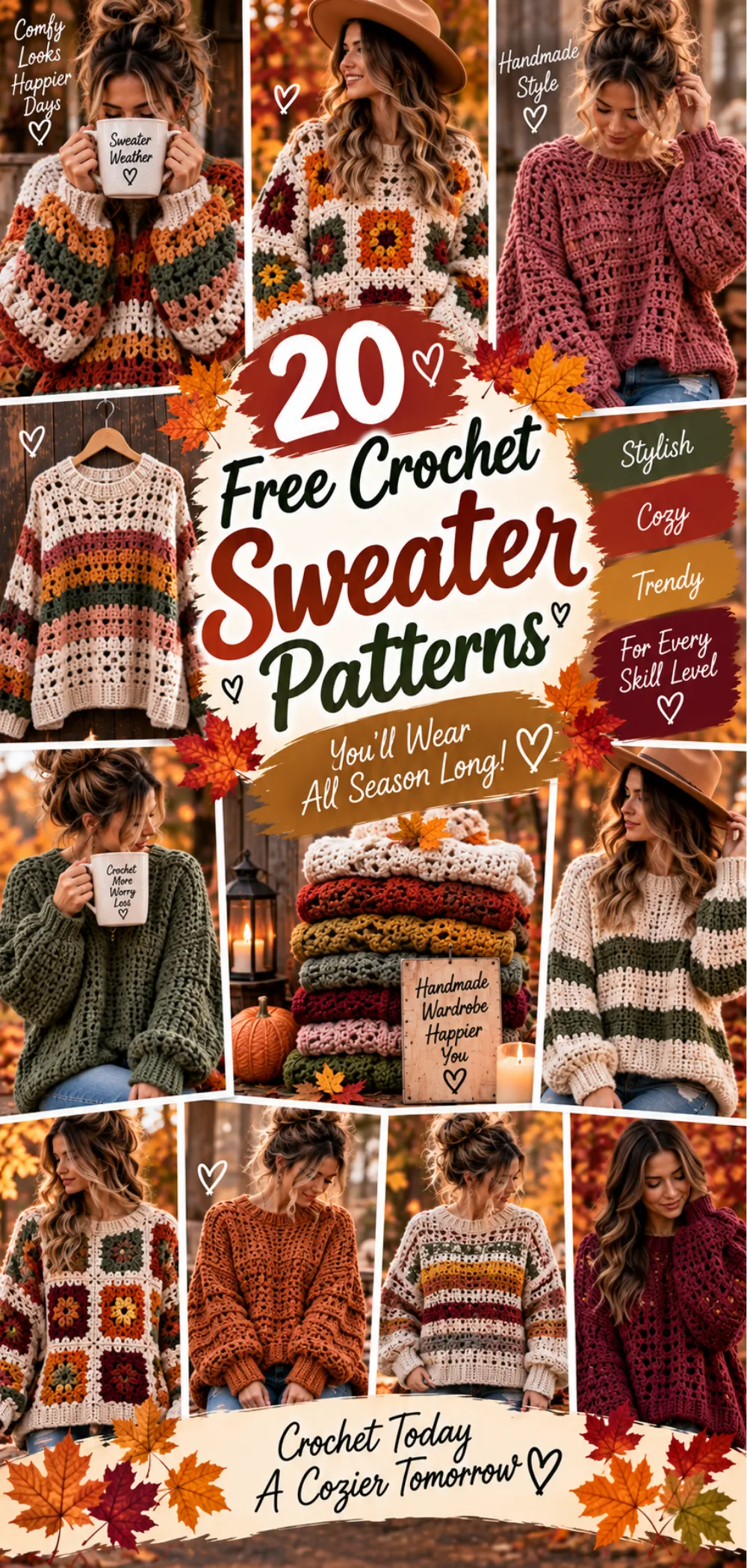
Crochet sweaters are not just garments; they are versatile and stylish pieces that can elevate any wardrobe. With the right pattern, you can create a cozy sweater that reflects your personal style and keeps you warm throughout the season. In this article, we present you with 20 Free Crochet Sweater Patterns You’ll Wear All Season, each designed to suit various occasions and skill levels.
From casual pullovers to elegant cardigans, the variety of designs available ensures that there is something for everyone. Whether you are a beginner or an intermediate crocheter, you will find patterns that challenge your skills while allowing you to express your creativity.
The joy of crocheting your own sweaters lies in the ability to personalize them. You can choose your favorite colors, adjust the fit, and even modify the patterns to create a unique piece that is truly yours. These sweaters can be adapted for different styles and seasons, making them a fantastic addition to your wardrobe.
IMAGE: A beautifully styled flat lay of several finished crochet sweaters in various colors and designs, displayed on a neutral background with natural lighting.
ALT: A collection of 20 free crochet sweater patterns displayed in a flat lay, showcasing stylish designs for every occasion.
CROCHET PATTERN QUICK OVERVIEW
| Detail | Information |
|---|---|
| Skill Level | Beginner to Intermediate |
| Crochet Terminology | US Terms |
| Yarn Weight | Various (DK, Worsted, etc.) |
| Crochet Hook Size | Varies (G to J) |
| Approximate Finished Size | Varies by pattern |
| Approximate Working Time | 2-5 hours per sweater |
| Construction Method | Worked in rows or rounds |
| Crochet Technique | Basic stitches and techniques |
| Pattern Type | Free crochet patterns |
ABOUT THIS 20 FREE CROCHET SWEATER PATTERNS YOU’LL WEAR ALL SEASON
Each of the 20 free crochet sweater patterns featured in this collection offers a unique construction method, allowing you to explore various techniques and styles. Some patterns are worked in rows, while others are crafted in rounds. Understanding the construction method is essential for achieving the desired fit and look of your sweater.
For instance, many of the patterns are designed to be worked in one piece, which minimizes the need for sewing seams. This approach not only simplifies the process but also creates a seamless finish that enhances the overall appearance of the garment. However, some designs may require you to join separate pieces, such as sleeves or panels, which can add an interesting dimension to your project.
As you work through these patterns, you will practice a variety of skills that are fundamental to crochet. Basic stitches such as single crochet (sc), double crochet (dc), and slip stitch (sl st) will be utilized throughout the designs. Additionally, you will learn shaping techniques that help create the contours of the sweater, such as increases and decreases, which are crucial for achieving the right fit.
Finishing techniques are also an important aspect of these patterns. You will gain experience in weaving in ends, adding borders, and ensuring that your sweater looks polished and professional. By the end of your crocheting journey, you will have not only a beautiful sweater but also enhanced skills that you can apply to future projects.
MATERIALS AND SUPPLIES
To create your beautiful crochet sweaters, you’ll need to gather specific materials. Choosing the right yarn and tools is essential for achieving the best results in your projects. Below is a list of the materials you’ll need to get started.
Ingredients:
- Yarn (various colors and types)
- Crochet hook (size depending on yarn)
- Scissors
- Tapestry needle
- Measuring tape
Make sure to select yarn that suits the style and season of your sweater. The right yarn can enhance the texture and drape of your finished piece.
IMAGE: A neatly arranged display of yarn skeins, crochet hooks, scissors, and other tools needed for the sweater patterns.
ALT: An organized collection of materials for crochet sweater patterns, including yarn, crochet hooks, and tools.
BEST YARN FOR 20 FREE CROCHET SWEATER PATTERNS
When selecting yarn for your crochet sweaters, consider the following types:
- Cotton: Great for lightweight and breathable sweaters, perfect for warmer seasons.
- Wool: Provides warmth and elasticity, ideal for cozy winter garments.
- Acrylic: Versatile and budget-friendly, available in a wide range of colors.
Each fiber has its benefits, so choose based on the season and the look you want to achieve. For example, cotton is excellent for summer wear, while wool is perfect for winter layers.
SUITABLE YARN SUBSTITUTIONS
If you can’t find the exact yarn specified in a pattern, don’t worry! You can often substitute with similar yarn types. Just remember to check the gauge and yardage to ensure your sweater fits as intended. Using a yarn with a similar weight and fiber content will help maintain the pattern’s integrity.
CROCHET HOOK AND ADDITIONAL TOOLS
The size of your crochet hook will depend on the yarn you choose. Here are some general guidelines:
- G Hook (4.0 mm): Suitable for lighter yarns like DK.
- H Hook (5.0 mm): Works well with worsted weight yarn.
- I Hook (5.5 mm): Ideal for bulkier yarns.
In addition to your crochet hook, having a few extra tools can make your crocheting experience smoother:
- Stitch markers to keep track of your rows or rounds.
- A measuring tape for checking your gauge and finished size.
- A tapestry needle for weaving in ends and finishing your project.
CROCHET STITCHES AND TECHNIQUES USED
To successfully create the 20 free crochet sweater patterns, you’ll need to be familiar with several essential stitches and techniques. These foundational skills will not only help you complete the patterns but also enhance your overall crocheting abilities. Below, we outline the key stitches and techniques you will encounter in these designs.
While some of these stitches may be new to you, many are commonly used in crochet. If you’re not yet familiar with any of the stitches mentioned, don’t worry! You can find helpful tutorials online that provide step-by-step instructions. Here are the primary stitches and techniques you will use:
- Single Crochet (sc)
- Double Crochet (dc)
- Slip Stitch (sl st)
- Chain Stitch (ch)
- Shell Stitch
DOUBLE CROCHET STITCH
The double crochet stitch (dc) is a fundamental stitch used in many of the sweater patterns. It creates a taller stitch compared to single crochet, which allows for more open and airy designs. This stitch is particularly important for adding texture and drape to your sweaters, making them comfortable and stylish.
To work a double crochet stitch, you will yarn over, insert your hook into the designated stitch, yarn over again, pull through, yarn over once more, and then pull through the last three loops on your hook. This technique not only builds height but also creates a lovely texture that enhances the overall look of your sweater.
IMAGE: A close-up of the double crochet stitch, highlighting its structure and insertion point.
ALT: A detailed view of the double crochet stitch used in crochet sweater patterns.
SHELL STITCH TECHNIQUE
The shell stitch technique is a decorative stitch that adds a beautiful, textured element to certain sweater designs. It typically consists of multiple double crochets worked into the same stitch or space, creating a “shell” effect. This stitch is often used in the body of the sweater or as a border to add visual interest.
To create a shell stitch, you will usually work a series of double crochets into the same stitch, often separated by chain stitches. This technique not only enhances the aesthetic appeal of your sweater but also provides a lovely drape and movement to the fabric.
Incorporating the shell stitch into your projects can elevate your crochet work, making your sweaters stand out with unique designs and textures.
CROCHET ABBREVIATIONS
Understanding crochet abbreviations is essential for following patterns accurately. Below is a simple table containing the common abbreviations used in the 20 free crochet sweater patterns, using standard US crochet terminology.
| Abbreviation | Meaning |
|---|---|
| ch | chain |
| dc | double crochet |
| sc | single crochet |
| st | stitch |
| sl st | slip stitch |
GAUGE
Gauge is a critical aspect of crochet, especially when creating garments like sweaters. It refers to the number of stitches and rows per inch in your crochet work. Achieving the correct gauge ensures that your finished sweater fits as intended. If your gauge is off, your sweater may end up too large or too small, which can be frustrating after investing time and effort into your project.
To determine your gauge, you will need to create a gauge swatch. This swatch is a small piece of crochet that allows you to measure your stitches and rows accurately. Here’s how to make a sample gauge swatch:
Sample Gauge Swatch Instructions:
- Using the yarn and hook specified in your pattern, chain 20 stitches.
- Work in the stitch pattern indicated in your chosen sweater pattern for at least 4 inches.
- After completing the swatch, measure the width and height of your swatch using a measuring tape.
- Count the number of stitches and rows within a 4-inch square. This will give you your gauge.
For example, if you find that you have 16 stitches and 10 rows in a 4-inch square, your gauge is 16 stitches per 4 inches and 10 rows per 4 inches. Make sure to note this down, as it will be essential for ensuring your sweater fits correctly.
If your gauge does not match the pattern’s specified gauge, you may need to adjust your hook size. If your swatch is too small, try using a larger hook. If it’s too large, switch to a smaller hook. Always recheck your gauge after making any adjustments.
By taking the time to measure your gauge accurately, you can ensure that your crochet sweater will fit beautifully and look great when completed.
STEP-BY-STEP INSTRUCTIONS FOR EACH SWEATER PATTERN
In this section, we will provide detailed instructions for each of the 20 free crochet sweater patterns. Each pattern includes a brief description, skill level, estimated time to complete, and step-by-step instructions to guide you through the crocheting process. Additionally, we will offer tips for customization and styling to help you make each sweater uniquely yours.
1. Cozy Chunky Sweater
Skill Level: Beginner
Estimated Time to Complete: 3 hours
This cozy chunky sweater is perfect for chilly days. It features a relaxed fit and is made using bulky yarn for quick results.
Instructions:
Row 1: Chain 60 (or desired width). Turn.
Row 2: In the 4th chain from the hook, work 1 dc. Continue to dc across. (58 dc)
Row 3: Ch 3, turn. Work 1 dc in each dc across. (58 dc)
Repeat Row 3 until the piece measures 24 inches from the starting chain.
Finishing: Fold the piece in half and seam the sides, leaving openings for the arms.
Customization Tip: Add a pocket or change the length to create a cropped version.
2. Elegant Lace Sweater
Skill Level: Intermediate
Estimated Time to Complete: 4 hours
This elegant lace sweater features a beautiful openwork design, making it perfect for layering.
Instructions:
Row 1: Chain 70. Turn.
Row 2: Work 1 sc in the 2nd chain from the hook, *ch 3, skip 2 chains, 1 sc in the next chain; repeat from * across. (23 lace sections)
Row 3: Ch 1, turn. Work 1 sc in each sc and 3 sc in each ch-3 space across.
Repeat Row 3 until the piece measures 22 inches.
Finishing: Seam the sides and add a simple border around the neckline.
Customization Tip: Experiment with different yarn colors for a unique look.
3. Classic V-Neck Sweater
Skill Level: Intermediate
Estimated Time to Complete: 5 hours
This classic V-neck sweater is a timeless piece that can be dressed up or down.
Instructions:
Row 1: Chain 80. Turn.
Row 2: Work 1 dc in the 4th chain from the hook and in each chain across. (78 dc)
Row 3: Ch 3, turn. Work 1 dc in each dc across.
Row 4: Ch 1, turn. Work 1 sc in the first 20 dc, ch 20, skip 20 dc, sc in the next 38 dc.
Repeat Row 3 until the piece measures 26 inches.
Finishing: Seam the sides and add ribbing to the cuffs and hem.
Customization Tip: Add stripes or color blocks for a modern twist.
4. Oversized Cardigan
Skill Level: Beginner
Estimated Time to Complete: 4 hours
This oversized cardigan is perfect for layering and features a simple stitch pattern.
Instructions:
Row 1: Chain 100. Turn.
Row 2: Work 1 dc in the 4th chain from the hook and in each chain across. (98 dc)
Row 3: Ch 3, turn. Work 1 dc in each dc across.
Repeat Row 3 until the piece measures 30 inches.
Finishing: Fold in half and seam the sides, leaving armholes.
Customization Tip: Add pockets or a belt for added style.
5. Textured Pullover
Skill Level: Intermediate
Estimated Time to Complete: 5 hours
This textured pullover features a unique stitch pattern that adds depth and interest.
Instructions:
Row 1: Chain 80. Turn.
Row 2: Work 1 sc in the 2nd chain from the hook, *ch 1, skip 1 chain, 1 sc in the next; repeat from * across.
Row 3: Ch 1, turn. Work 1 sc in each sc and ch-1 space across.
Repeat Row 3 until the piece measures 24 inches.
Finishing: Seam the sides and add ribbing to the neckline.
Customization Tip: Use a variegated yarn for a fun effect.
TIPS FOR SUCCESS
Whether you’re a beginner or an intermediate crocheter, these tips will help you achieve a successful project with your crochet sweaters. By following these guidelines, you can enhance your crocheting experience and create beautiful, well-fitted garments.
1. Take Your Time with Gauge
Always check your gauge before starting your sweater. This step is crucial for ensuring that your finished piece fits as intended. If your gauge swatch does not match the pattern’s specifications, adjust your hook size accordingly. Remember, it’s better to take a little extra time at the beginning than to end up with a sweater that doesn’t fit.
2. Maintain Consistent Tension
Consistent tension is key to achieving an even fabric. If you find that your stitches are too tight or too loose, practice adjusting your grip on the yarn. Try to keep your tension uniform throughout the project to avoid uneven edges or puckering. If you notice any inconsistencies, take a moment to relax your hands and refocus.
3. Use Stitch Markers
Stitch markers are invaluable tools for keeping track of your rows or rounds, especially in larger projects. Place a stitch marker at the beginning of each row or round to help you easily identify where to start your next stitch. This practice can prevent confusion and help maintain your stitch count.
4. Troubleshoot Common Issues
If you encounter problems while crocheting, such as missed stitches or accidental increases, take a moment to assess the situation. Here are some common issues and how to address them:
- Missed Stitches: If you notice a gap or hole, check your previous rows to see if you skipped a stitch. You can often fix this by carefully frogging back to the last complete row and reworking it.
- Uneven Edges: If your edges are uneven, ensure that you are consistently working the same number of stitches at the beginning and end of each row. Consider adding a border to help even out the edges.
- Twisted Starting Chains: If your starting chain is twisted, it’s best to unravel and start over. A twisted chain can lead to an uneven foundation and affect the overall look of your sweater.
5. Finishing Techniques Matter
Finishing techniques can make a significant difference in the appearance of your sweater. Take the time to weave in all loose ends neatly, and consider adding a border or ribbing to the neckline and cuffs for a polished look. Blocking your finished sweater can also help shape it and enhance the stitch definition, making your work look more professional.
6. Personalize Your Sweater
Don’t hesitate to customize your sweater patterns! You can change colors, add embellishments, or modify the length to create a piece that truly reflects your style. Experimenting with different yarns and stitches can also lead to unique results that set your sweater apart from others.
By following these tips, you can ensure a smoother crocheting experience and create beautiful sweaters that you’ll be proud to wear all season long. Happy crocheting!
CARING FOR YOUR CROCHET SWEATERS
Proper care and maintenance of your crochet sweaters are essential to keep them looking great and prolong their lifespan. Different yarn types require specific care methods, so it’s important to follow the guidelines below based on the fiber content of your sweater.
Washing Your Crochet Sweaters
When it comes to washing your crochet sweaters, always check the yarn label for specific care instructions. Here are some general tips:
- Cotton: Cotton sweaters can usually be machine washed on a gentle cycle in cold water. Avoid using bleach, as it can weaken the fibers.
- Wool: Wool sweaters should be hand washed in cold water with a mild detergent. Avoid agitating the fabric too much to prevent felting.
- Acrylic: Acrylic yarn is typically machine washable. Use a gentle cycle with cold water, and avoid fabric softeners, which can affect the texture.
Regardless of the yarn type, it’s best to turn your sweater inside out before washing to protect the surface from pilling and snagging.
Drying Your Crochet Sweaters
How you dry your crochet sweaters can significantly impact their shape and texture:
- Cotton: Lay flat to dry on a clean, dry towel or a drying rack. Avoid hanging, as this can stretch the fabric.
- Wool: Always lay wool sweaters flat to dry. Never wring out excess water, as this can distort the shape. Instead, gently press the water out by pressing the fabric between two towels.
- Acrylic: Acrylic sweaters can also be laid flat to dry. They dry quickly, so check frequently to avoid over-drying.
Never use a dryer for crochet sweaters, as the heat can cause shrinkage and damage the fibers.
Storing Your Crochet Sweaters
Proper storage is key to maintaining the shape and quality of your crochet sweaters:
- Folding: Always fold your sweaters instead of hanging them. Hanging can lead to stretching and misshaping, especially for heavier yarns.
- Cool, Dry Place: Store your sweaters in a cool, dry place away from direct sunlight to prevent fading and damage. Avoid damp areas, as moisture can lead to mold and mildew.
- Use Storage Bags: Consider using breathable storage bags or bins to protect your sweaters from dust and pests. Avoid plastic bags, as they can trap moisture.
By following these care tips, you can ensure that your crochet sweaters remain beautiful and wearable for many seasons to come. Taking the time to care for your handmade garments will keep them looking fresh and new, allowing you to enjoy your creations for years ahead.
CONCLUSION
As you explore the 20 Free Crochet Sweater Patterns You’ll Wear All Season, we hope you find inspiration in the variety of designs available. Each pattern offers a unique opportunity to express your creativity and style, whether you’re looking for something cozy for everyday wear or an elegant piece for special occasions.
We encourage you to dive into these patterns, experiment with different yarns, and make each sweater your own. Don’t hesitate to customize the designs to reflect your personal taste, and enjoy the process of creating something beautiful and functional.
Once you’ve completed your projects, we invite you to share your finished sweaters and experiences with the crochet community. Your creations can inspire others and foster a sense of connection among fellow crocheters. Happy crocheting!
Print
20 Free Crochet Sweater Patterns You’ll Wear All Season – Stylish Designs for Every Occasion
- Total Time: 2-5 hours depending on complexity
- Yield: 1 sweater per pattern
- Diet: N/A
Description
Explore 20 free crochet sweater patterns that are stylish and perfect for any occasion throughout the season.
Ingredients
- Yarn (various colors and types)
- Crochet hook (size depending on yarn)
- Scissors
- Tapestry needle
- Measuring tape
Instructions
- Choose your desired crochet sweater pattern from the list.
- Gather all necessary materials including yarn and crochet hook.
- Follow the pattern instructions step by step.
- Make sure to check your gauge before starting.
- Complete the sweater by finishing off the edges and weaving in any loose ends.
Notes
- Consider using different yarn weights for varied textures.
- Substitutions can be made with similar yarn types.
- Store finished sweaters in a cool, dry place to maintain their shape.
- Prep Time: 30 minutes
- Cook Time: Varies by pattern
- Category: Crochet
- Method: Crocheting
- Cuisine: N/A
Nutrition
- Serving Size: N/A
- Calories: N/A
- Sugar: N/A
- Sodium: N/A
- Fat: N/A
- Saturated Fat: N/A
- Unsaturated Fat: N/A
- Trans Fat: N/A
- Carbohydrates: N/A
- Fiber: N/A
- Protein: N/A
- Cholesterol: N/A